Reading the Wires: What Cable Colours Reveal About a UK Home Before You Buy

Photo: electrician inspecting old consumer unit wiring colours UK home, via www.niagaracollege.ca
Most buyers walk into a property and look at the kitchen, the roof and the boiler. Very few lift the lid on the consumer unit. Yet the wiring concealed in a house is one of the few elements that cannot be cosmetically refreshed in a weekend, and its age shapes both the safety case and the budget for years to come. A visual read of cable colours is one of the simplest ways to begin forming a view.
None of what follows replaces a proper inspection. It is, however, a reasonable way to ask better questions before you exchange contracts.
Why conductor colours changed at all
For decades, British single-phase installations used red for the line conductor and black for neutral, with green-and-yellow (or, in much older work, plain green or bare copper) for the circuit protective conductor. Three-phase work followed a red, yellow and blue convention with a black neutral.
In March 2004, BS 7671 adopted harmonised European colours. Single-phase line conductors became brown, neutral became blue, and the earth remained green-and-yellow. Three-phase arrangements moved to brown, black and grey with a blue neutral. The transition was permitted until 31 March 2006, after which the new colours were required for new work.
That two-year overlap matters. It explains why a great many UK homes contain a mixture of both conventions, and why a single glance at a cable is not the whole story.
What a colour can and cannot tell you
A brown-and-blue installation suggests work carried out after 2006, or at least new circuits added since then. Red-and-black points to older cabling, though it may still be perfectly serviceable — PVC-insulated twin-and-earth of 1970s or 1980s vintage is a very different proposition from rubber-insulated cable of the 1940s and 1950s, which is well past any reasonable service life.
What colour cannot tell you is condition. Cable that has been overheated, damaged by rodents, drilled through and poorly repaired, or loaded beyond its design will not announce itself through its sheath. Nor does the colour of the conductors reveal the size of the protective device, the presence of earthing and bonding, or whether the Earth Fault Loop Impedance is adequate.
The practical value of a visual check is therefore about dating rather than judging. It narrows the range of possibilities and tells you what to ask next.
Five places worth looking
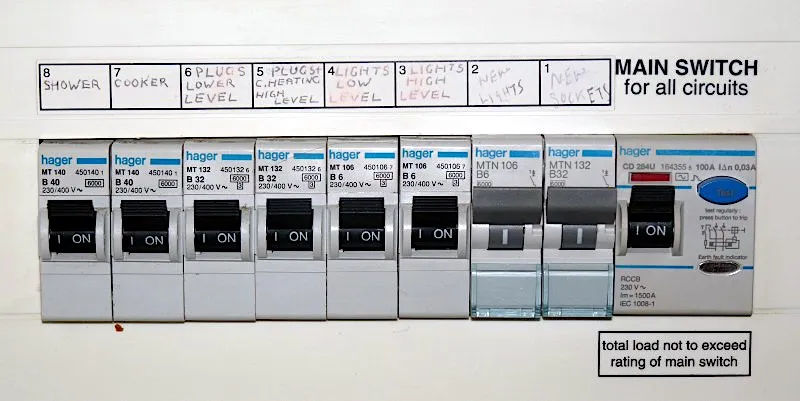
- The consumer unit. A modern board with miniature circuit breakers and residual current devices, a clear schedule and space for labelling suggests relatively recent work. A wooden-backed board with rewireable fuses indicates the installation has not been substantially upgraded, even if the wiring behind it was partly renewed.
- Conductor colours at the main switch or outgoing ways. Brown and blue serving the whole board is a strong hint of a full rewire or replacement board after 2006; a mix of red and brown feeding different ways suggests a piecemeal history.
- The outer sheath. Grey PVC is standard for twin-and-earth. Black rubber or fabric-braided cable, or lead-sheathed cable at the meter position, is a clear signal of an installation long overdue for replacement.
- Accessories. Sockets and switches are replaced far more often than cable, so they are unreliable evidence on their own — but a very old round-pin socket left in service, or a light switch with no earth connection to the metal box, is worth noting.
- The meter tails. Aluminium tails or undersized tails between the meter and the consumer unit are common findings in older properties and may need replacing as part of any upgrade.
Mixed colours: usually untidy, rarely dangerous
A board containing both red and brown conductors is not, by itself, unsafe. The Wiring Regulations permit a conductor to be identified at its terminations, and it is entirely normal for a brown sleeving to be fitted over a red conductor, or a red sleeve over a brown one, where a new accessory is connected to an old circuit. What matters is that identification is clear and consistent, and that anyone working on the circuit later can tell which conductor is which.
Where mixed colours should prompt a question is when they point to circuits added without documentation, borrowed neutrals, or DIY alterations that have left junctions inaccessible beneath floors. Those are matters of workmanship, not palette.
The genuinely concerning observations are different in character: a lack of circuit protective conductors on lighting circuits installed before the mid-1960s, signs of overheating at terminations, a complete absence of RCD protection on socket outlets that could reasonably supply outdoor equipment, or main protective bonding that is missing from the gas and water intakes.
Where an EICR fits into a purchase
An Electrical Installation Condition Report is not a legal requirement for an owner-occupied purchase in England and Wales, and a mortgage valuation is not an electrical inspection. It remains, nonetheless, the most reliable way to establish the condition of an installation before you commit.
A typical EICR is a non-invasive inspection with agreed limitations; the electrician will sample, test and observe rather than dismantle the fabric of the building. The report will record the condition of the installation, identify any departures from BS 7671 that are considered potentially dangerous, and grade observations accordingly. Armed with that, you can either proceed with confidence, negotiate, or budget for remedial work with your eyes open.
Commissioning one before exchange gives you leverage. Commissioning one after completion gives you a to-do list.
Practical next steps for buyers and renovators
If the wiring looks old, do not panic and do not assume the worst. Ask the seller for any electrical certificates, Building Regulations completion certificates or EICRs relating to work carried out during their ownership. Ask when the consumer unit was last replaced and by whom. Then arrange for a registered electrician to carry out an EICR at the earliest sensible opportunity.
If you are planning a renovation, bear in mind that any notifiable work in England and Wales must comply with Part P of the Building Regulations, and that the most economical moment to rewire is while floors are up and rooms are empty. A rewire planned alongside a refurbishment costs a fraction of one carried out in a finished, occupied home.
Colours are a starting point, not a verdict. They tell you what questions to ask — and a good electrician will answer them properly, in writing, before you sign.